
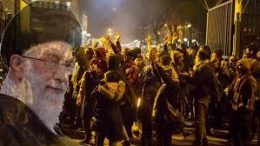
Protests and clashes with police and security services have erupted across Iran over the past few days, involving broad sectors of society. The unrest follows a near-collapse of the economy after decades of political repression, international sanctions, and widespread hopelessness. Media reports suggest that there are growing calls for the removal of the current regime and expressions of support for the U.S.-exiled son of the deposed Shah of Iran, Reza Pahlavi, who shares his father’s name.
The Iranian regime came into existence following the events of 1979, when the British-backed Shah was removed and replaced by Ayatollah Khomeini under the banner of an “Islamic revolution,” with the support of the Iranian military. While Khomeini’s links to the United States were understood by astute political observers, BBC Persian later released documents and correspondence demonstrating a relationship between Khomeini and U.S. officials dating back to the 1960s. In one such communication, Khomeini reportedly stated that he had no reservations about American intervention in Iran.
After his removal, Shah Reza Pahlavi wrote in his memoirs that the U.S.-trained Iranian army and security services had betrayed him following a secret mission by U.S. General Robert Huyser to meet Iran’s army chief shortly before the Shah was deposed. In addition, Gary Sick, U.S. National Security Advisor under President Jimmy Carter, revealed in his book October Surprise a secret agreement between Khomeini and Ronald Reagan. According to Sick, American embassy staff taken hostage in Tehran were deliberately not released until after Carter had lost the election, an arrangement with which Khomeini complied.
Khomeini’s relationship with Washington was further detailed by a close confidant who later became Iran’s president and was subsequently removed from office. In his book My Turn to Speak: Iran, the Revolution and Secret Deals with the United States, he published confidential documents seized by students during the takeover of the U.S. embassy—documents that had been shredded and painstakingly reconstructed.
Since then, the Iranian clerical regime has remained subservient to American interests in the region, despite its overt posture of hostility toward the United States. Central to this claim is the role of Khomeini’s deputy and successor, Ali Khamenei. Accordingly, as The Political Awakening covered in extensive detail, Iran’s coordination with the U.S. and Israel over Gaza revealed a deeper alignment, including alleged cooperation through the provision of intelligence to Israel that facilitated the targeting of Hezbollah’s leadership. This, in turn, contributed to Israel’s security and the removal of Iran and Hezbollah from Syria, paving the way for the U.S. to replace Bashar al-Assad with Ahmed al-Sharaa, with the support of Turkey and President Recep Tayyip Erdoğan.
This points to what can be described as American protection of the Iranian leadership, which also became apparent when under the pretext of attacks on Iran’s nuclear facilities, intelligence was provided to Israel to eliminate members of Iran’s security and military hierarchy, particularly those who had recognized what they saw as the regime’s betrayal of Hezbollah and Syria, and those pushing for full nuclear weapons capability, a position Iran’s spiritual leader and American agent, Khamenei opposed. This protection was, in their view, made explicit when President Donald Trump openly forbade any attack on Khamenei himself, while allowing strikes against the military leadership.
Against this backdrop, both the United States and Britain are closely observing current events. The unrest may represent, for Britain in particular, its strongest opportunity yet to escalate the situation and potentially draw the United States into Iran’s internal crisis—especially given what some describe as the most prominent demand so far among protesters for the return of Reza Pahlavi.
It is therefore notable that despite Trump’s initial threats, when he stated, “I have let them know that if they start killing people, which they tend to do during their riots… we’re going to hit them very hard”, his tone has since become more cautious. He has openly refused to back Reza Pahlavi, saying, “I think that we should let everybody go out there, and we’ll see who emerges,” adding that it would not necessarily be “appropriate” for him to support Pahlavi (Axios, 9/01/2026).
The online platform further reported on 9 January 2026 that “Early this week, U.S. intelligence assessed that the protests lacked sufficient energy to challenge the stability of the regime,” while simultaneously quoting a U.S. official who stated that “The protests are serious, and we will continue to monitor them.”
These developments have reportedly generated nervousness within the Iranian leadership and concern over the reliability of American backing. Following Trump’s statements on his Truth Social platform that “If Iran shots and violently kills peaceful protesters, which is their custom, the United States of America will come to their rescue….We are locked and loaded and ready to go,” senior adviser to Khamenei, Ali Larijani, issued what can be interpreted as a veiled plea. He warned that any U.S. intervention would “lead to destabilizing the entire region and destroying American interests.” ie the Iranian regime.
As for Britain, the silence of Prime Minister Keir Starmer and the perceived bias of the BBC have been conspicuous. Uncertain of Trump’s ultimate intentions and reluctant to appear openly supportive of Pahlavi in a way that might conflict with Washington, the British government has refrained from official comment. From this perspective, escalation in Iran could serve British interests by drawing the Trump administration into a prolonged internal crisis.
Ultimately, much will depend on the stance of Iran’s military and security services. These institutions are likely to be decisive in determining the outcome of the unrest, as well as the extent to which the United States can influence events. For now, Washington appears to lack a clear alternative to the current clerical leadership, suggesting that it may still hope the regime can regain control of the streets.

Be the first to comment on "Contemporary Unrest in Iran: Political Legitimacy, External Influence, and Regime Stability"