
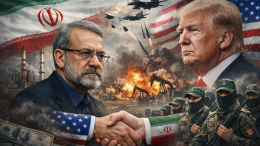
Negotiations, Strikes, and Succession: The Strategic Reordering of Power in Iran

For decades, U.S.–Iran relations have followed a recurring pattern: whenever Washington approaches a potential deal with Tehran that could lift sanctions and end isolation, external pressures intensify. Britain and other European powers often raise concerns, emphasising Iran’s internal repression or regional conduct. The most recent round of diplomacy has followed a similar trajectory.

According to the Financial Times (26/02/26), Iran offered the United States significant economic incentives as part of efforts to secure a nuclear agreement and avoid war. The paper reported:

“Iran is aiming to tempt Donald Trump with financial incentives, including investments in its vast oil and gas reserves, as part of efforts to convince the US president to agree a deal on its nuclear programme and avoid war. One person familiar with the matter described the prospect of a ‘commercial bonanza’, with Tehran seeking to appeal to Trump’s penchant for deals promising a financial dividend for the US.”

This approach echoed earlier remarks by Iranian Deputy Foreign Minister Araghchi, who wrote in The Washington Post (April 8, 2025):

“It is the U.S. administrations and congressional impediments, not Iran, that have kept American enterprises away from the trillion-dollar opportunity that access to our economy represents.”

Iran’s Foreign Ministry spokesperson Esmail Baghaei declined to outline the precise terms of the proposal but referred to Araghchi’s public articles highlighting economic cooperation:

“In those articles, Araghchi talks about oil, gas and energy, where we have advantages and need modern technology, and where there is strong capacity,” Baghaei told the FT.

On 24/02/26, Araghchi further stated that Iran did not intend to pursue nuclear weapons:

Iran “will under no circumstances ever develop a nuclear weapon” and would seek a “fair and equitable deal — in the shortest possible time.”

Notably, Araghchi also told U.S. media:

“We have not offered any suspension, and the US side has not asked for zero enrichment.”

The Financial Times further reported that Iranian officials explicitly framed negotiations around shared economic interests:

“Hamid Ghanbari, a deputy foreign minister, told Iranian businessmen this month that ‘common interests in the fields of oil and gas, including joint fields [with neighbouring countries], as well as investments in mining and even the purchase of civilian aircraft, have been included in the talks with the US’” (26/02/26).

Taken together, the negotiations increasingly appeared structured less around nuclear rollback and more around sanctions relief and economic integration — particularly U.S. access to Iran’s vast energy sector. Some analysts suggested that such an arrangement could position Washington to exert substantial influence over Iranian oil and gas, drawing comparisons with recent U.S. involvement in Venezuela’s energy industry.

However, this trajectory risked undermining European and British interests, which have historically sought access to Iranian markets but have been constrained by U.S. sanctions regimes.


Military Escalation Amid Negotiations

The subsequent military strikes by America and Israel on Iran appeared, at first glance, to contradict the diplomatic track — especially given Araghchi’s categorical denial of nuclear weapons ambitions and the introduction of major economic incentives into negotiations.

Yet the military action appears less connected to the talks themselves and more aligned with facilitating a political transition in Tehran — particularly given the advanced age and ill health of Supreme Leader Ayatollah Ali Khamenei.

Donald Trump publicly framed regime change as a primary objective and called upon the Iranian people to “take control.” However, no coherent civilian opposition exists capable of leading such a transition. Responsibility would therefore likely fall upon Iran’s military establishment, particularly the Islamic Revolutionary Guard Corps (IRGC).

Trump directly threatened the IRGC and called on them to surrender. Historically, regime change through air power alone is rare. As The New York Times (28/02/26) noted:

“It is a high-risk move: There are almost no successful examples in modern history of regime change through an air campaign. But administration officials, including Vice President JD Vance, have made clear they imagine a swift campaign with no U.S. troops on the ground.”

With ground deployment publicly ruled out, the strikes appear calibrated to create pressure, legitimacy, and cover for an internally managed transition — likely involving pre-positioned actors.

One figure repeatedly mentioned is Ali Larijani, former head of the IRGC, who has not been specifically targeted in the strikes. President Masoud Pezeshkian’s statement that military units were “taking decisions independently” further fuelled speculation that power may be consolidating within military circles.

In an interview with CBS News, Trump stated he “knows exactly” who is calling the shots in Tehran and added that “there are some good candidates” to replace the supreme leader. He did not elaborate. Speaking to The Atlantic (01/03/26), Trump added:

“They want to talk, and I have agreed to talk, so I will be talking to them. They should have done it sooner. They should have given what was very practical and easy to do sooner. They waited too long.”


Managed Confrontation?

Iran’s military response has been widely described as restrained and symbolic. Reports indicate that targeted U.S. bases in the Gulf had been evacuated in advance, and missile exchanges were limited.

The Financial Times (28/02/26) observed:

“When the US struck Iran in June last year, Tehran’s response was swift, but was choreographed with Washington to avoid escalation which Trump thanked them for. Air defences shot down Iranian missiles aimed at Al Udeid, which had been emptied.”

The absence of significant mobilisation by Iran’s regional proxies — including Hezbollah and groups in Iraq and Yemen — further suggests coordination or at minimum acquiescence within Iran’s military establishment.

Iran possessed the capacity to escalate regionally but refrained from doing so. This restraint strengthens speculation that communication exists between American officials and elements within Iran’s military and security apparatus, potentially preparing the ground for a transition.


The Elimination of Khamenei and Senior Leadership

The major strike was the elimination of Ayatollah Khamenei and numerous senior Iranian leaders in coordinated strikes by Israel and America. Trump subsequently declared that 48 senior Iranian figures had been killed.

This marked the end of a long era in Iran’s leadership. Speculation now centres on a restructured leadership model potentially overseen by Ali Larijani, who remains unscathed.

Britain notably did not participate in the strikes and reportedly declined U.S. use of its bases. Meanwhile, Reza Pahlavi, son of the former Shah, has been positioned symbolically in opposition circles but has received limited visible backing from Washington.

Copyright © LCIR 2026

Be the first to comment on "Negotiations, Strikes, and Succession: The Strategic Reordering of Power in Iran"

Leave a comment

Your email address will not be published.


*