
Venezuela and Greenland in the Architecture of America’s Strategic Entrapment of China

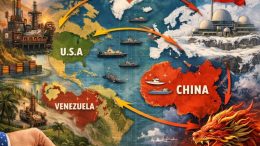
Recent American military actions in Venezuela, threats directed at the regimes of Colombia and Cuba, and the renewed reiteration of Trump’s position on acquiring Greenland, even through military means, must be viewed as components of a larger global jigsaw aimed at the entrapment of China. The United States has laid specific traps and plans across multiple regions, the South China Sea, South Asia, and beyond—to lure China into carefully designed confrontations, halt its military expansion, and ultimately destroy its capacity to rival American power.

The open imperialistic nature of these actions, which risk destabilising the very global order the United States built and relied upon for its hegemony, underscores Washington’s growing frustration at its failure to curtail China’s rise, particularly in the military realm, which it regards as the most dangerous element of state power and the greatest threat to its dominance. Consequently, efforts to provoke and lure China militarily—whether over Taiwan or through theatres such as Afghanistan, have become central to American political and strategic thinking.

Having failed thus far to lure China into a military takeover of Taiwan, the brazen militaristic actions and statements concerning Venezuela and Greenland are designed to create precedents that provide China with both the prompt and perceived legitimacy to seize Taiwan.

While many analysts have incorrectly attributed U.S. actions to oil, minerals, the petrodollar, or drugs, these explanations function largely as masks to conceal a deeper U.S. policy. They align with the classic definition of political action: “to openly declare your actions but to hide your aims.”

To the astute political observer, these hidden aims become apparent. The United States already controls the Western Hemisphere; there is no meaningful threat to its dominance in the region. America is also a net oil exporter, eliminating any urgent need to exploit Venezuelan oil, which it has long regarded as a strategic reserve should the need arise. Moreover, Venezuela registers minimally on the drug issue when compared with Colombia and other U.S.-aligned South and Latin American countries.

With regard to Greenland, there is similarly no strategic necessity for American military control. The United States already operates a military base on the island, Denmark has agreed to U.S. investment in rare earth minerals, and Washington has been granted broad latitude to expand military security in the Arctic alongside NATO. A military takeover would therefore be counterproductive, likely splintering NATO and provoking severe international backlash.

Thus, America’s public statements and actions mask the true target: China.

This trap becomes evident when observing that, alongside Trump’s statements on military action, U.S. media outlets have provided significant airtime to Trump’s hawkish adviser Stephen Miller, projecting ideas of American force and imperialism. The New York Times described this as “part of a vocal push… to justify American imperialism and a vision for a new world order in which the United States could freely overthrow national governments and take foreign territory and resources so long as it was in the national interest” (7/01/26).

In a CNN interview broadcast globally on 06/01/26, Miller articulated these views bluntly:

“We live in a world, in the real world that is governed by strength, that is governed by force, that is governed by power…These are the iron laws of the world since the beginning of time.”

In line with these comments, Miller advocated that should America seize Greenland, “Nobody’s going to fight the United States militarily over the future of Greenland,”

With regard to Venezuela, Miller stated emphatically that “The United States of America is running Venezuela,” dismissing international treaties enshrining a nation’s right to independence and sovereignty as “international niceties.”

He further asserted:

“We set the terms and conditions…We have a complete embargo on all of their oil and their ability to do commerce. So for them to do commerce, they need our permission. For them to be able to run an economy, they need our permission. So the United States is in charge. The United States is running the country.”

These brazen public statements, coordinated with Trump’s own rhetoric and amplified globally, are not coincidental. They form part of a calculated strategy: first, to tempt China into using American precedent to justify a takeover of Taiwan; and second, to strengthen Russian President Putin’s hand regarding captured Ukrainian territory, leaving Europe in a state of strategic uncertainty.

By using its own “backyard” as the trap, the United States has effectively torn up the international legal order—an order that China and Europe publicly rely upon to constrain American power. By undermining principles of sovereignty, independence, and prohibitions on the use of force, China’s public denunciations of international norm violations risk appearing weak and irrelevant.

So far, China has refrained from adopting the U.S. approach or falling into the trap, instead maintaining its emphasis on international legitimacy. According to the Global Times, a mouthpiece of the Chinese state:

“In response to media inquiry about the US’ forcible seizure of Venezuelan leader Nicolás Maduro and his wife and their transfer out of the country, which has drawn widespread attention and prompted some people on Taiwan island to express concern that the Chinese mainland might follow the US approach to “justify taking action against Taiwan,” Chen Binhua, the spokesperson from the Taiwan Affairs Office of the State Council, said that the US has brazenly used force against a sovereign country, a move that seriously violates international law, infringes on the sovereignty of other states, and threatens regional peace and security. We firmly oppose this” (06/01/26)

The United States is working aggressively to construct multiple political traps for China, with its actions in Venezuela and statements regarding Greenland forming integral pieces of this jigsaw. Yet the growing number and severity of these traps also reveal American frustration: its policies have thus far failed to curtail China’s continued advance, regional confidence, and consolidation of power.

Copyright © LCIR 2026

Be the first to comment on "Venezuela and Greenland in the Architecture of America’s Strategic Entrapment of China"

Leave a comment

Your email address will not be published.


*